Do we need to know the outcome of the work we make before we start?
Louise Despont works intuitively, allowing her drawings to develop as she creates them. Using pencils, rulers, stencils, and compasses, she produces dense, colourful, large-scale, meditative works that aim to capture energy or feeling rather than something we can see or touch.
Use the below videos and questions to build up an understanding of Louise Despont’s drawings and see how you can bring her methods into making your own work.
Please Note:
This page includes links and videos from external sites, verified at publication but subject to change.
Teachers should review all content for classroom suitability.
Report any issues, and check school firewall settings if videos don’t play.




Louise Despont
“[In drawing] the downshift in speed is what opened the door for information and inspiration to step through”
Louise Despont is an artist whose practice focuses on drawing. Her works comprise of detailed geometric drawings which evolve organically. The making of the artwork, and the outcomes, are powerful, meditative and mindful.
She lives in USA and Bali.
www.louisedespont.com/
Nicelle Beauchene Gallery
In the TedTalk below, Louise Despont shares why she thinks drawing is so important both to herself and to us all as human beings.
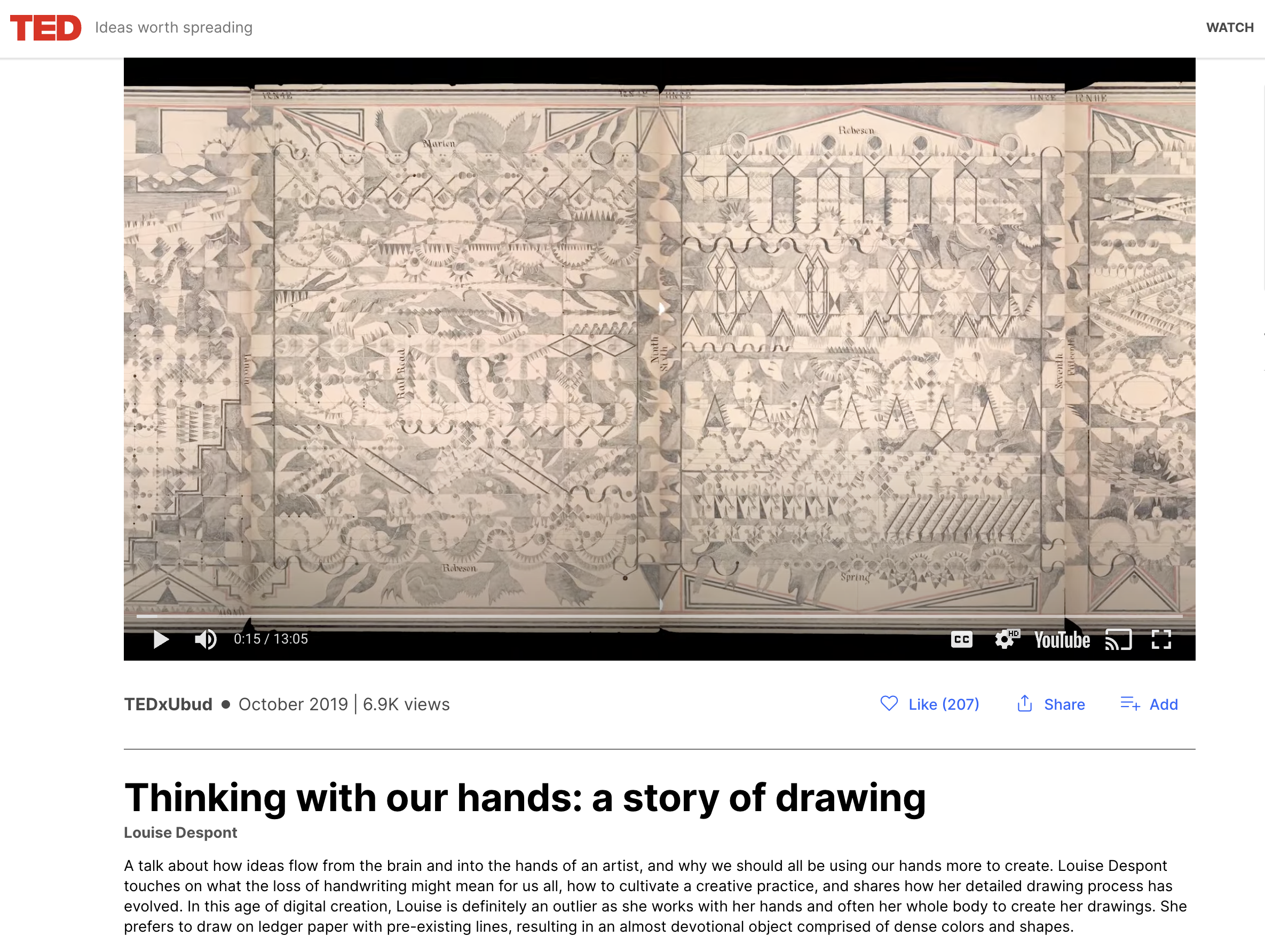
How and where Louise finds inspiration…
Questions to Ask Children
Do you think Louise has a clear idea of the outcome before she starts each piece?
How long do you imagine she works on each piece? How does she know when a piece is finished? Is a piece ever finished?
How do the drawings make you feel?
How would it feel to make drawings like that?
Louise gives advice:
-
Look at your work upside down for a new perspective.
-
Reorganise your pages to see if there isn’t an entirely different story inside the one you had.
What do you think she means by this advice, and can you apply it to your own work?
Look around you. Could you begin to collect images or objects, using your instinct, that you are attracted to. Could you use them as a starting point to draw? What tools could you use to help you draw?
This Talking Points Is Used In…
Pathway: Exploring pattern
This is featured in the ‘Exploring Pattern’ pathway
using sketchbooks to make visual notes
Show me what you see