A collection of sources to explore Chauu masks in performances.
Please note that this page contains links to external websites and has videos from external websites embedded. At the time of creating, AccessArt checked all links to ensure content is appropriate for teachers to access. However external websites and videos are updated and that is beyond our control.
Please let us know if you find a 404 link, or if you feel content is no longer appropriate.
We strongly recommend as part of good teaching practice that teachers watch all videos and visit all websites before sharing with a class. On occasion there may be elements of a video you would prefer not to show to your class and it is the teacher’s responsibility to ensure content is appropriate. Many thanks.
Chhau Masks
Chhau dance is a semi classical Indian dance with martial and folk traditions. It is found in three styles named after the location where they are performed, i.e. the Purulia Chau of West Bengal, the Seraikella Chau of Jharkhand and the Mayurbhanj Chau of Odisha.
The dance ranges from celebrating martial arts, acrobatics and athletics performed in festive themes of a folk dance, to a structured dance with religious themes. The costumes vary between the styles, with masks being used to identify the characters.
The stories enacted by Chhau dancers include those from Indian literature.
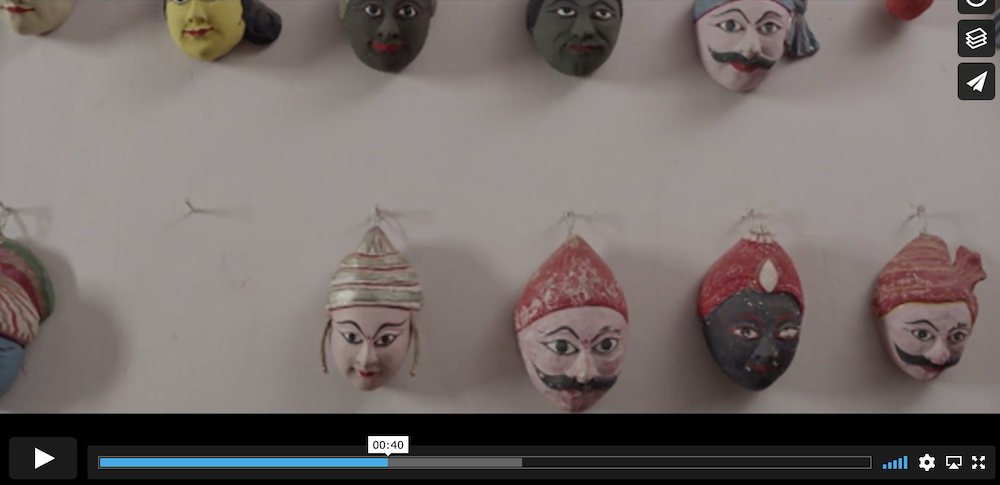
Click on the image above to find out more about Seraikella Chhau Dance.
Questions to Ask Children
How do the masks make you feel?
How do you feel watching parts of the performance?
How would you describe the colours?
What kinds of materials are used to make the masks?
A collection of sources to explore contemporary artists who create masks.
Please note that this page contains links to external websites and has videos from external websites embedded. At the time of creating, AccessArt checked all links to ensure content is appropriate for teachers to access. However external websites and videos are updated and that is beyond our control.
Please let us know if you find a 404 link, or if you feel content is no longer appropriate.
We strongly recommend as part of good teaching practice that teachers watch all videos and visit all websites before sharing with a class. On occasion there may be elements of a video you would prefer not to show to your class and it is the teacher’s responsibility to ensure content is appropriate. Many thanks.
Romuald Hazoumè
West African artist Romuald Hazoumé creates contemporary African masks made using discarded plastic containers, in particular petrol canisters. The petrol canisters are used by lots of people in West Africa and represent the artist’s heritage. They also represent his critical vision of political systems.
“I send back to the West that which belongs to them, that is to say, the refuse of consumer society that invades us every day.”
Questions to Ask Children
How do the masks make you feel?
Do you like the masks? Why?
What do you think the artist is trying to say through the artwork?
What other recycled or waste materials could we use to make masks?
Damselfrau
Damselfrau focuses on play and make as few conscious decisions as possible to let the materials lead. Damselfrau design the masks as she makes, responding to materials as opposed to a drawn design.
The masks are perhaps more accurately described as wearable sculptures. The ornate creations fuse the boundaries between fashion and design.
Questions to Ask Children
How do these masks make you feel?
How do these masks compare to Romuald’s masks?
If you encountered someone wearing the of the masks how would you feel?
Thalassic Masks
The Thalassic Masks project focuses on rethinking the protective mask, transforming a medical product, born in a state of emergency, into a design statement expressing contemporary identities.
The artists Filippo Nassetti and Vincezo Reale believe that beyond Covid-19, further implications of climate change and the disruption of ecological environments, such as air pollution and transformations in the atmosphere, may see protective devices become more and more an essential extension of the human body.
Questions to Ask Children
Do you like the Thalassic masks?
How does the mask make you feel?
Do you think that it’s an improvement on the surgical masks you’ve had to wear over the past 2 years?
A collection of imagery and sources designed to explore different flip books.
Please note that this page contains links to external websites and has videos from external websites embedded. At the time of creating, AccessArt checked all links to ensure content is appropriate for teachers to access. However external websites and videos are updated and that is beyond our control.
Please let us know if you find a 404 link, or if you feel content is no longer appropriate.
We strongly recommend as part of good teaching practice that teachers watch all videos and visit all websites before sharing with a class. On occasion there may be elements of a video you would prefer not to show to your class and it is the teacher’s responsibility to ensure content is appropriate. Many thanks.
*If you are having issues viewing videos it may be due to your schools firewall or your cookie selection. Please check with your IT department.*
This resource is free to access and is not a part of AccessArt Membership.

Animate the Earth
Animate the Earth uses a book as the foundation for the flip book. Using an old book is a good way to make a flip book quickly. The background text can also add some character to the animation. You could even use the story line or theme of the book to inspire the storyline of your flip book.
Questions to Ask Children
Do you like the background of words on a page? Why?
What is your favourite part of the animation?
Do you think the artist planned what was going to happen next or was just playing with what is possible?
Colibri Flip Book
Graphite and coloured pencil on paper, stainless steel, delrin, motor electronics 10x10x12.7 CM.2011 By J. C. Fontanive
J. C. Fontanive
Fontanive invented the first flip book machine in his bedroom from old bike, car and clock parts and vinyl records. The invention explores moving image, form and structure. Multiple frames are shown in sequence to form the animation. The fluttering of the paper provides a natural soundtrack bring the still images to life.
Quiknesse, 2009 flipbook machine
Questions to Ask Children
What kind of bird do you think that this features in these flip book machines?
Which is your favourite and why?
Does the painted background of Quiknesse add anything to the flip book machine? If so, what?
What bird would you like to see in a flip book machine?
Volume 5 of Harumin Asao’s Cat series
Harumin Asao is a Japanese illustrator who uses flip books as a way to create short and playful animations.
Using small pages for flip books gives a nice control when flipping through as opposed to bigger thinner pages.
Questions to Ask Children
What your favourite animal?
Think about how that animal might greet you when you get home.
Flip Book Within a Flip Book
The Flippist creates hand drawn flip books as a career, from engagement proposals to more commercial projects the Flippest has made a flip book for every occasion.
Questions to Ask Children
If you could make a flip book for any occasion what would it be?
Whats your favourite part of this flip book and why?
What other objects could replace the volcano and leak out of the flip book?
A collection of imagery and sources designed to introduce children to the process of linocut.
Please note that this page contains links to external websites and has videos from external websites embedded. At the time of creating, AccessArt checked all links to ensure content is appropriate for teachers to access. However external websites and videos are updated and that is beyond our control.
Please let us know if you find a 404 link, or if you feel content is no longer appropriate.
We strongly recommend as part of good teaching practice that teachers watch all videos and visit all websites before sharing with a class. On occasion there may be elements of a video you would prefer not to show to your class and it is the teacher’s responsibility to ensure content is appropriate. Many thanks.
Linocut
Teachers Notes
Linocut print is a printmaking technique used for relief printing. The surface of the Linoleum is cut into with sharp V shaped tools to create a design.
Linocut originates from the technique ‘woodcut’. In this process a block of wood is used to carve from instead of linoleum. Woodcut is the oldest form of printmaking with records of its use on textiles from as long ago as the twelfth century.
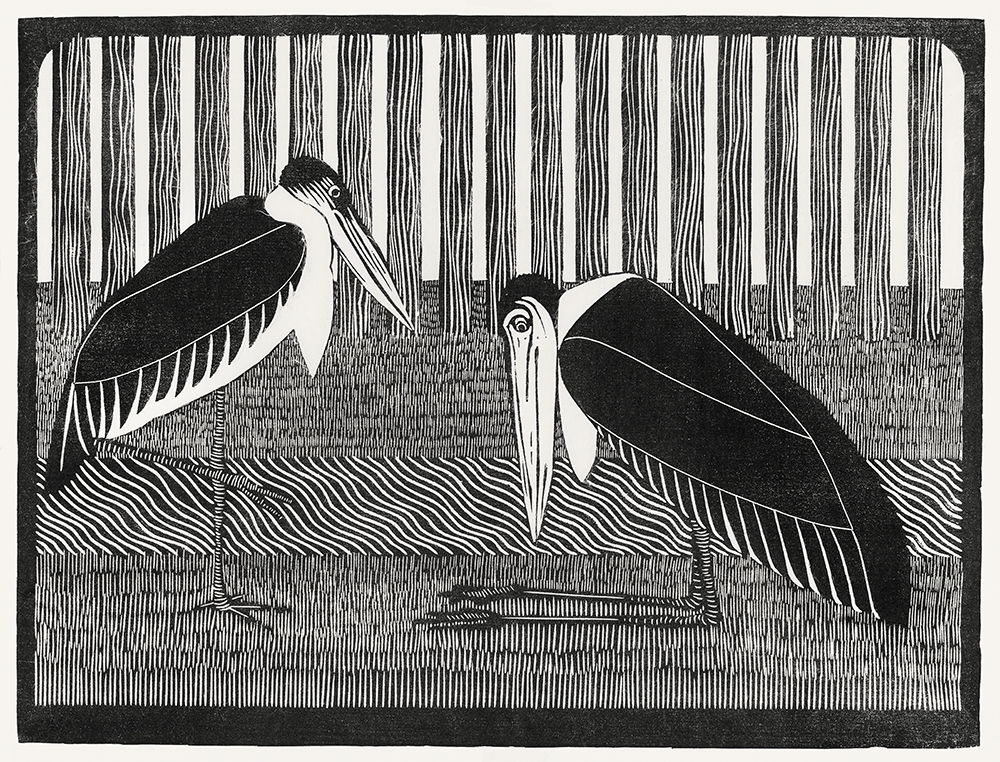
Two maraboos (Twee maraboes) (c.1914) by Samuel Jessurun de Mesquita. Original from The Rijksmuseum. CC0
A collection of imagery and sources designed to introduce children to the process of letterpress.
Please note that this page contains links to external websites and has videos from external websites embedded. At the time of creating, AccessArt checked all links to ensure content is appropriate for teachers to access. However external websites and videos are updated and that is beyond our control.
Please let us know if you find a 404 link, or if you feel content is no longer appropriate.
We strongly recommend as part of good teaching practice that teachers watch all videos and visit all websites before sharing with a class. On occasion there may be elements of a video you would prefer not to show to your class and it is the teacher’s responsibility to ensure content is appropriate. Many thanks.
This resource is free to access and is not a part of AccessArt Membership.
Letterpress
Teachers Notes
Letterpress is a relief printing technique. For hundreds of years letterpress was the only way to create reproductions of text. The invention of the letterpress in the mid 15th Century meant that information could be more accessible to the masses. Traditionally, the letters are arranged, a roll is inked and the raised surface of the letters are pressed against sheets or a continuous roll of paper.
Take a online tour of Robert Smail’s Printing Works in Scotland. Founded in 1866 and now part of the Scottish National Trust, the tour walks you through the rooms, different jobs and the machinery used in the victorian era.
A modern day letterpress process.
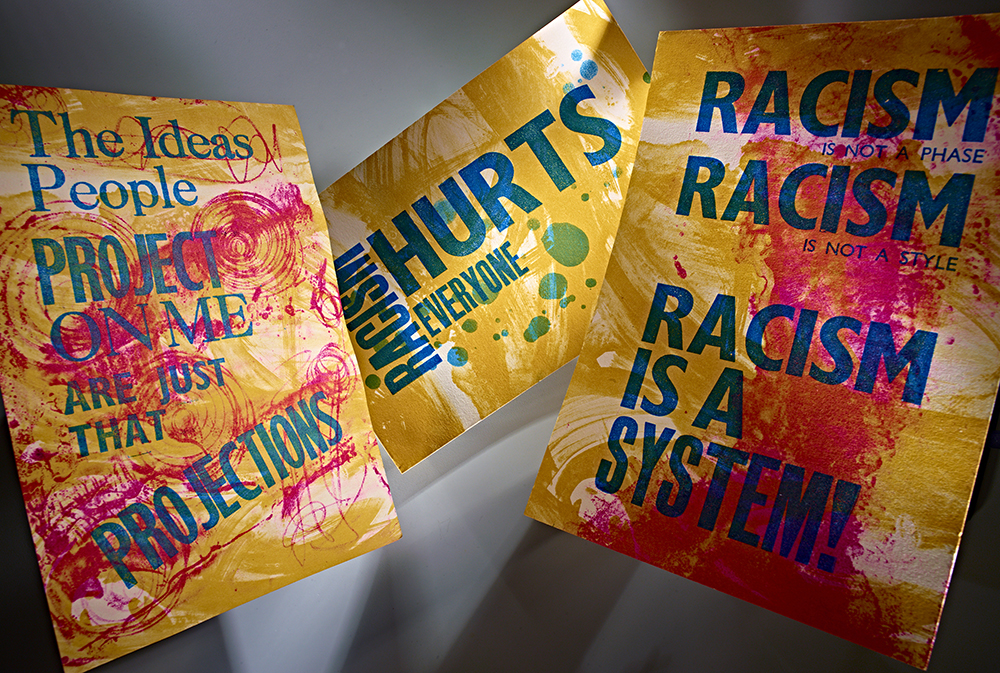
Alan Kitching, Letterpress artist, talking about his process and inspirations whilst working on a commission for English Heritage
Farewell Etaoin Shrdlu, a 30 minute documentary on the last day of typesetting at The New York Times in 1978, before the switch to computers.
Features interviews for and against the incoming technology, plus a look at the end showing the contrast between the old typesetting methods and the new computerised version.
Talking Points
What sort of things was letterpress traditionally used for?
What do people still use letterpress?
What differences are there between designing on a computer nowadays and using old methods such as letterpress?
Why do you think there is still an interest in using old technology today?
Can you think of any other old techniques used to make art that are still being used?
Why is (or is?) it important to understand old techniques and ways of making things?
How have computers changed how we make art?
What do you think is next for printing techniques? What comes after computers?
A collection of imagery and sources designed to introduce children to the process of Collagraph.
Please note that this page contains links to external websites and has videos from external websites embedded. At the time of creating, AccessArt checked all links to ensure content is appropriate for teachers to access. However external websites and videos are updated and that is beyond our control.
Please let us know if you find a 404 link, or if you feel content is no longer appropriate.
We strongly recommend as part of good teaching practice that teachers watch all videos and visit all websites before sharing with a class. On occasion there may be elements of a video you would prefer not to show to your class and it is the teacher’s responsibility to ensure content is appropriate. Many thanks.
This resource is free to access and is not a part of AccessArt Membership.
Collagraph
A collagraph print is made from textured materials collaged together on a piece of card. Lots of materials can be used to make collagraphs including (but not limited to) sand, fabric, bubblewrap, string and cardboard.
The surface of the plate can also be cut away at or into to create different marks.
Sinclair Ashman
Watch this video to find out about how printmaker Sinclair Ashman found his passion for collagraph.
Karen Wicks
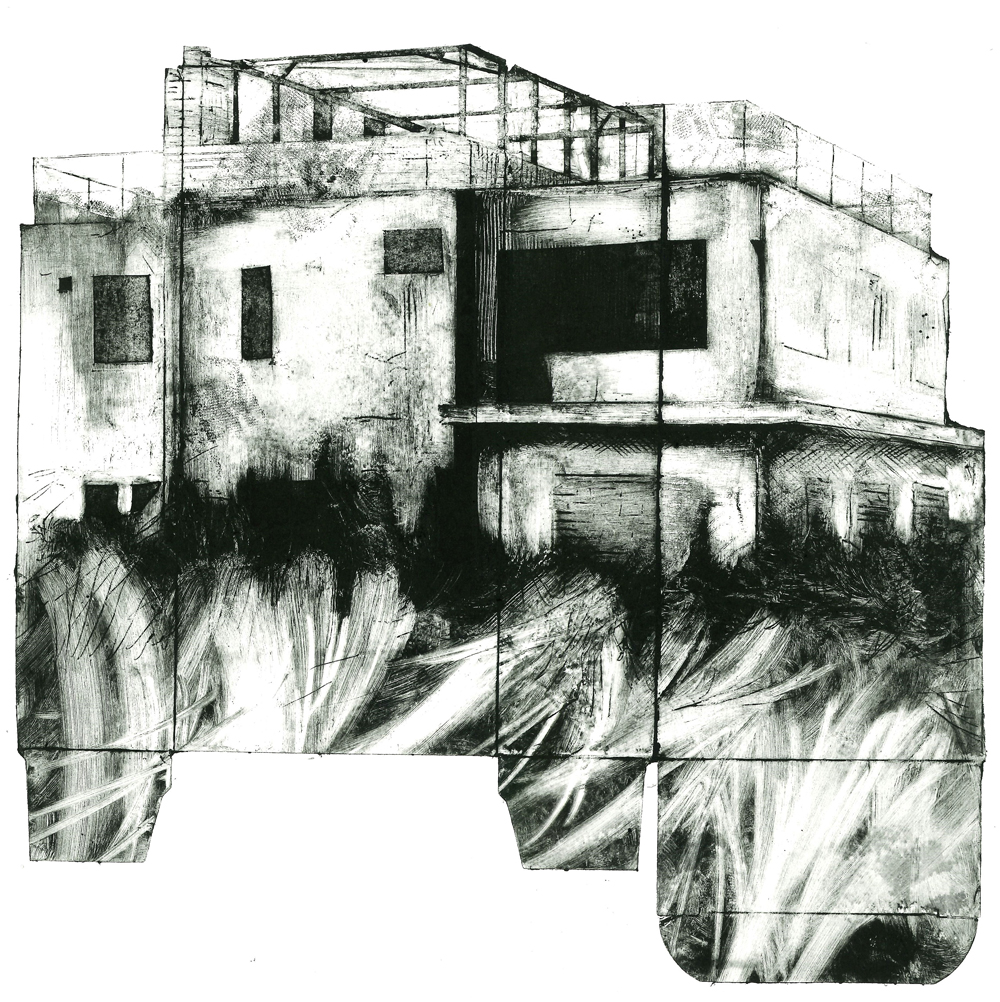
RAF Tangmere by Karen Wicks Medium: Collagraph Paper Type: Fabriano Unica (250gsm) Year: 2022.
Explore this resource by Karen Wicks to find out how she makes her prints here.
A collection of imagery and sources designed to stimulate conversation around the work of Alvaro Naddeo.
Please note that this page contains links to external websites and has videos from external websites embedded. At the time of creating, AccessArt checked all links to ensure content is appropriate for teachers to access. However external websites and videos are updated and that is beyond our control.
Please let us know if you find a 404 link, or if you feel content is no longer appropriate.
We strongly recommend as part of good teaching practice that teachers watch all videos and visit all websites before sharing with a class. On occasion there may be elements of a video you would prefer not to show to your class and it is the teacher’s responsibility to ensure content is appropriate. Many thanks.
Alvaro Naddeo
“Art has a political role. I believe we as artists can and should put subjects to be discussed, to be reflected upon, and to be talked about.”
Alvaro Naddeo is originally from São Paulo, Brazil and currently in Los Angeles, USA.
Alvaro’s father was an illustrator and Alvaro spent much of his childhood drawing, however he moved into advertising as a profession. Recently he returned to make his own artwork.
Alvaro wears contact lenses or glasses to correct his “bad eyesight” but he doesn’t like to wear glasses when he paints. When he takes his glasses off, the world is blurry, except when he is very close up to his work, at which point it is focussed. He thinks this is why he enjoys creating so much detail in his paintings.
In terms of subject matter, Alvaro credits his years working in advertising as being an influence. He paints recognisable brands and disposable objects which are both attractive to us and also remind us of our tendency towards wasting resources.
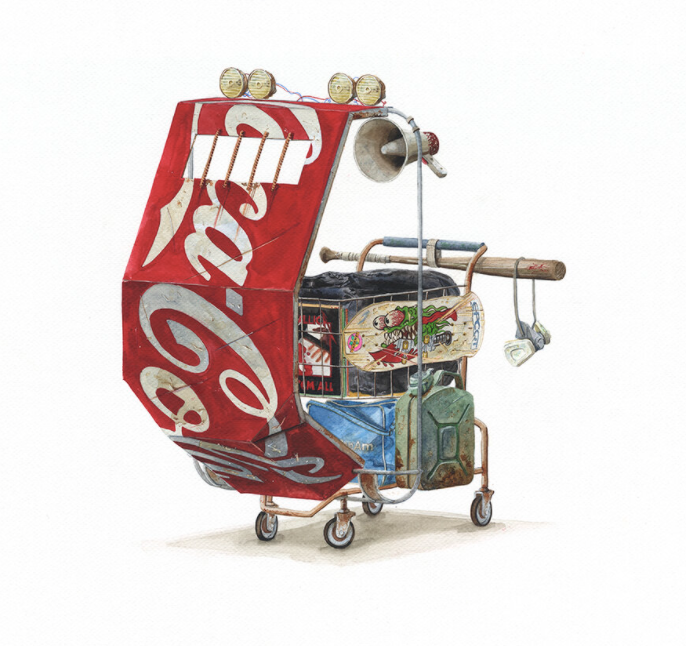
“The subject matter of my work is waste, overconsumption and social inequality” Alvaro Naddeo
Please note in the video below there is a small and brief detail of a woman’s torso. As teacher pls decide if you want to show the video.
Apologies if you cannot view the video below on Youtube if your school has blocked Youtube.
Questions to Ask Children
Take a really close look at Alvaro’s work on his website. Notice how his work changes over time.
What do you think Alvaro’s main interest are? How many different elements / objects does he bring into one piece? How does he connect them? Does he play with scale?
How do you think Alvaro uses his skill as a painter to draw attention to issues which he thinks are important?
How long do you spend looking at each painting? Do you understand more about the work the longer you spend looking?
See This Resource Used In Schools…
You May Also Like…
Pathway: Drawing and Making Inspired by Maurice Sendak
Visual Arts Planning Collections: Toys, puppets, dolls
talking points: maurice sendak