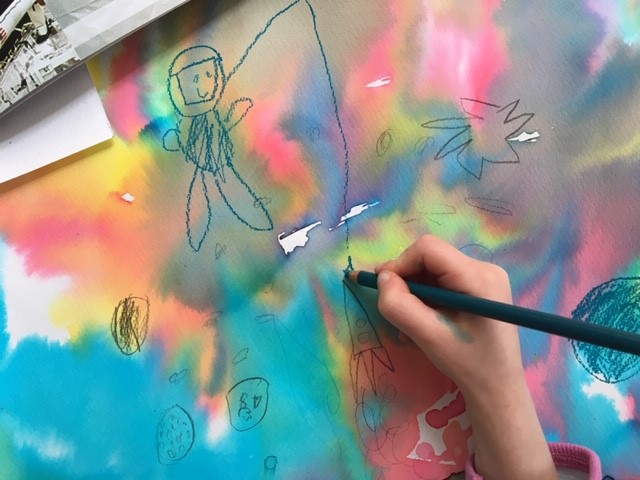
Galaxy Painting

By Rachel Thompson

Add space drawings once paint is dry

In this table top activity, AccessArt team member Rachel uses a classic water colour technique to create a colourful galaxy scene.

You will need:

  • Some large water colour paper (unfortunately standard cartridge paper is not absorbent enough for this activity!)
  • Water colour paints, inks or food colouring
  • Pippets and/or brushes
  • Test tubes, jug and funnel (if you don’t have test tubes then a standard paint pallet or a few pots work fine)
  • A small sponge
  • An ice cube tray or other colour mixing pots

To create a link between art and science, we used some equipment taken from a ‘science kit’ we have – namely, pippets, test tubes, a funnel and food colouring – but you can just as easily use paint brushes and water colour paint or inks. The advantage of pippets and funnels however, is that it creates a few more steps to the process, (therefore taking more time, keeping engagement up for more than twenty minutes!).
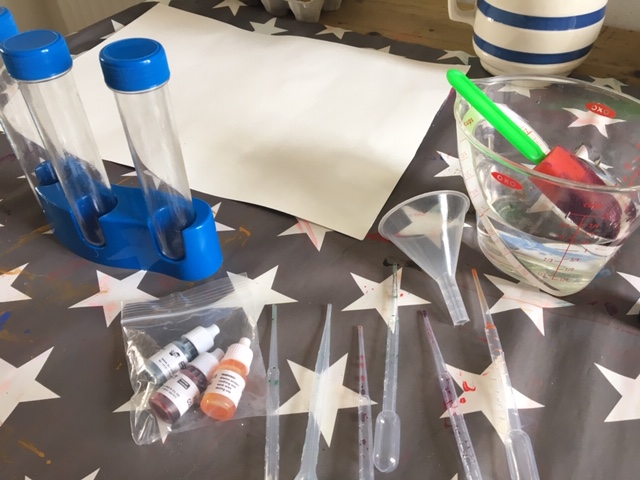
equipment needed for galaxy painting

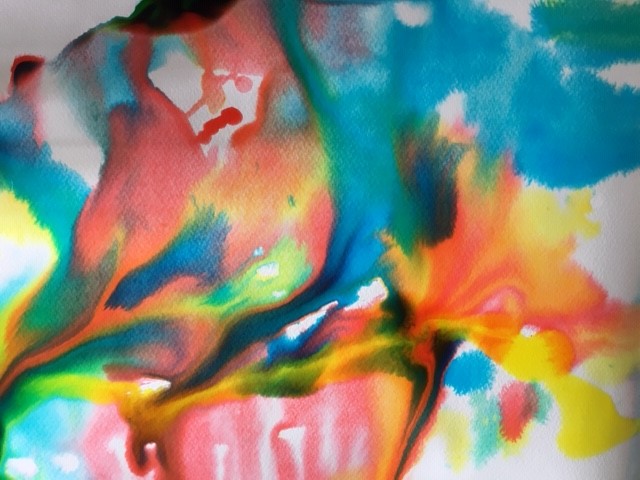
This activity uses a classic water colour technique of applying paint to a dampened piece of paper. The result is that the paint shows its lovely quality of travelling and swirling across the paper through the channels of wet paper. Young children love to see how colours can ‘magically’ merge together and create beautiful moving patterns.

Starter discussion: This is a great opportunity to combine a bit of art with science! Take a look at photos or books of how our galaxy looks. Observe the colours and patterns and talk about where space is and how we learn about it. I did this activity with my five year old daughter and a few minutes discussing space galaxies definitely seemed to help her focus!

Then, we used the test tubes to mix our colours. This proved an engaging part of the process as we could use a small funnel and jug of water to first add some water into each tube, followed by some drops of food colouring. Inks or water colour paint work equally well here though.
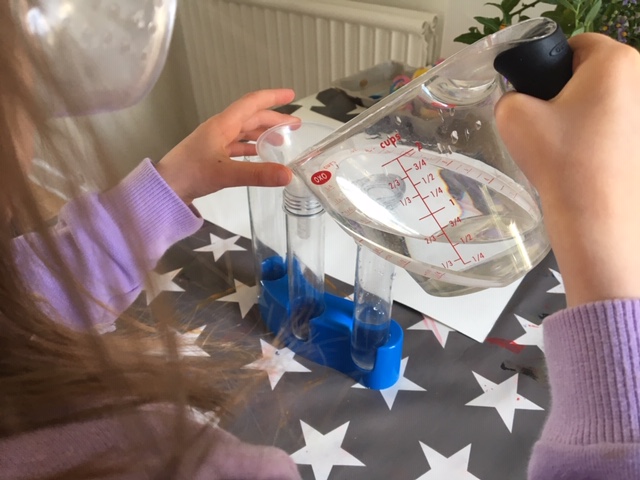
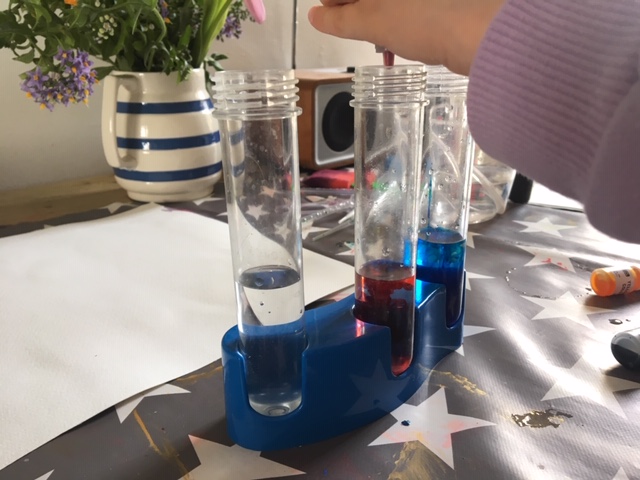
pour some water into the test tubes

add food colouring to the water

Primary colours work well here as there’s more scope for creating new colours.
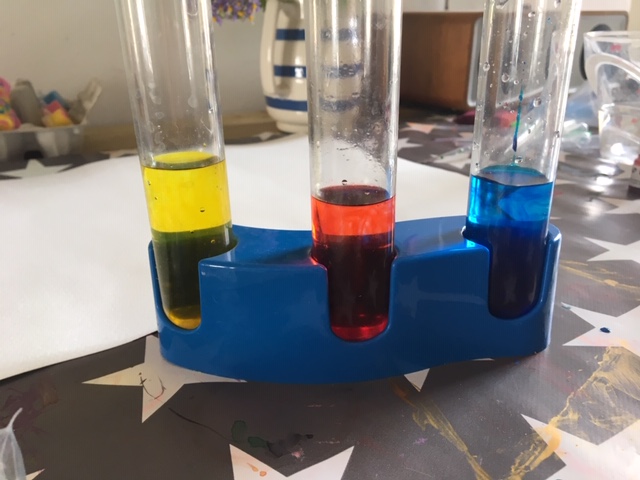
colours ready for washing over the paper

Then, take a large sheet of water colour paper that is as absorbent as possible. Using a sponge or large brush, spread some water across the paper evenly. Try not to make it too wet at this stage or the paper will become too saturated once the colour is added.
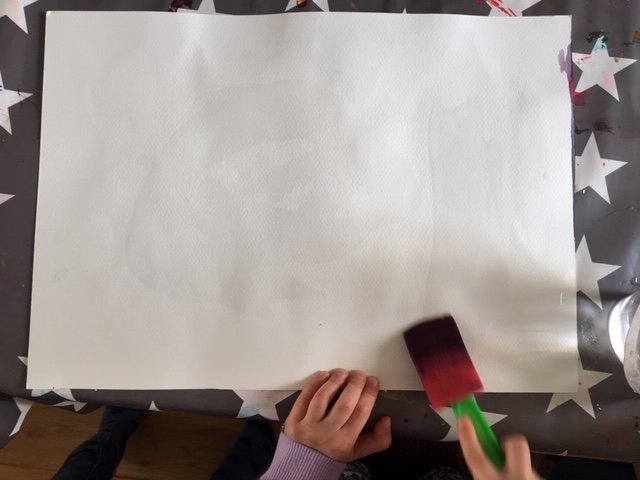
applying water to absorbent paper

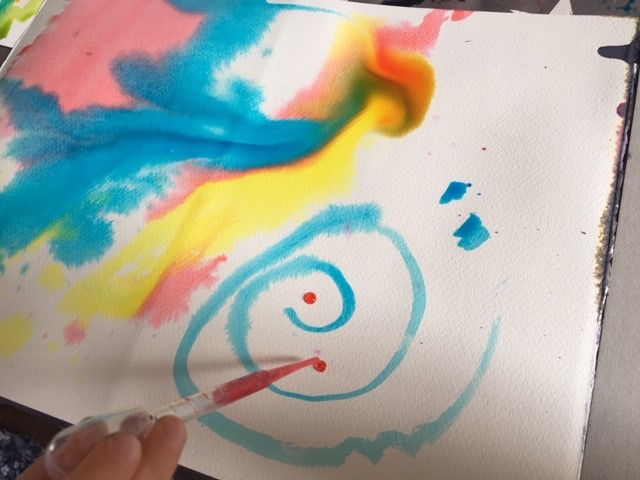
Next, use pippets (or brushes) to drop colour onto the dampened paper – and wait for the magic to happen!
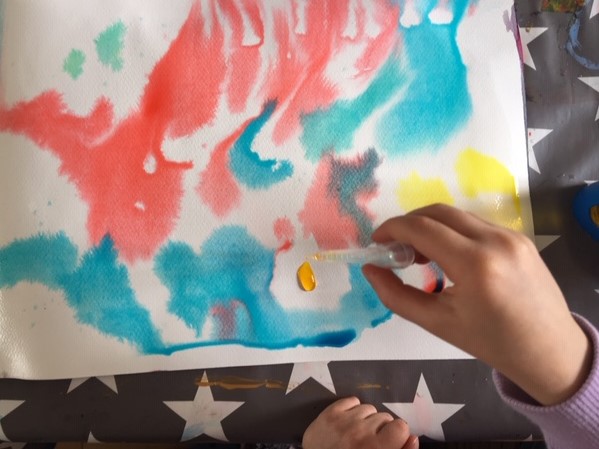
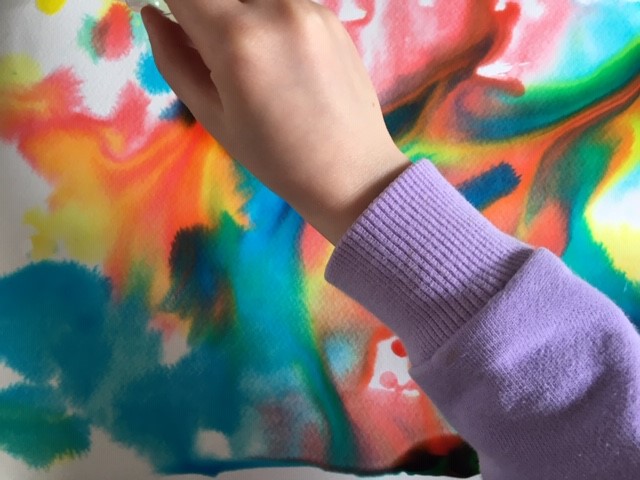
dropping colour onto the dampened paper


creating patterns

creating spiral patterns

Create patterns with brushes and drop colour in between.
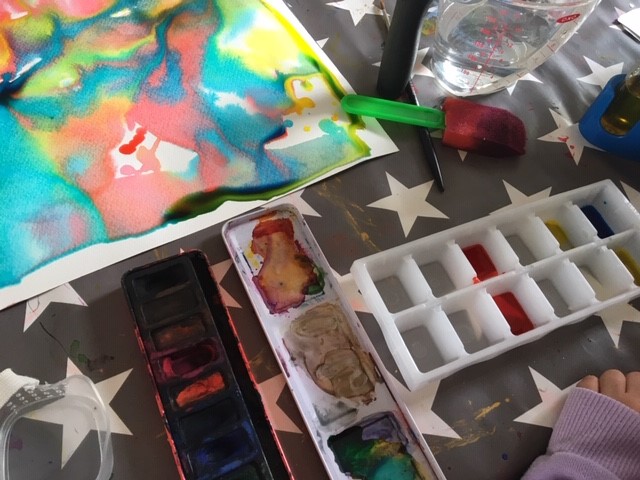
using an ice cube box to colour mix

After a few minutes I introduced an old ice cube box that was useful for playing with colour mixing. I also got out a set of water colour paints to add variety.
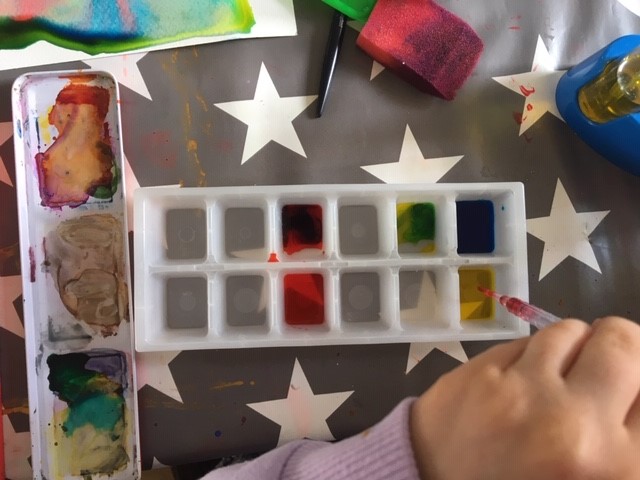
colour mixing using an ice cube tray

Spending a few minutes dropping colour into each ice cube section was an activity in itself!

Once the paper has been covered with colour, and is probably getting to the point where it can’t hold much more water, set it aside to dry. If little puddles of coloured water are pooling on the paper, show your child how they can extract this using the pippet. This is a great technique to learn and encourages the child to make decisions about their painting and where sometimes, less is more! You can also do this with a dry paint brush, making sure you squeeze or blot the fluid out of it each time.

Once the painting is dry we moved on to looking at some space books, so some context was given for the next part of the activity.
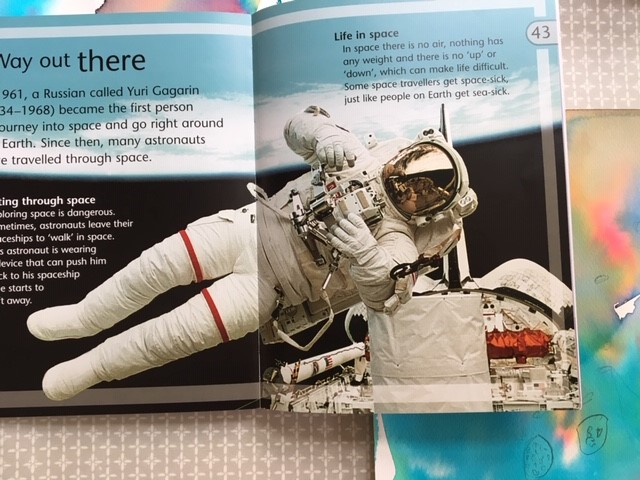
looking at space books for inspiration

Then, using a range of drawing materials (my daughter mainly used simple colouring pencils as they have a lovely chalky quality over the top of dried water colour paper) draw your space picture! This is really an opportunity to let your child use their imagination and explore the composition of the page. Allow them to draw what comes to mind, only steering them towards discussions about space rather than dictating what they draw. My daughter was particularly drawn to a photo of an astronaut in the book we looked at and so wanted to re create that.

She began drawing some planets, some with rings around them.
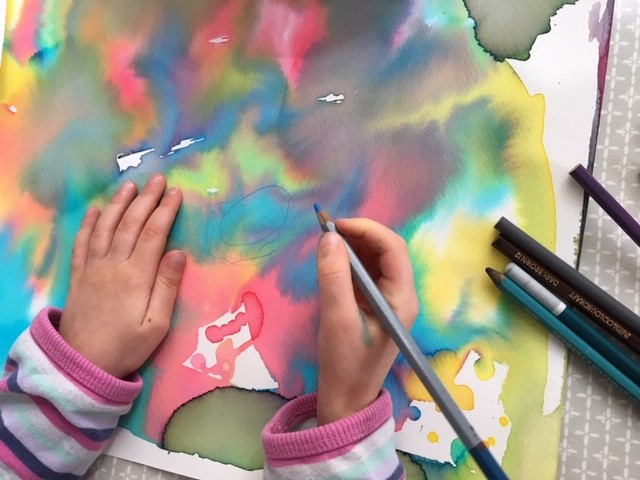
drawing over the dried water colour

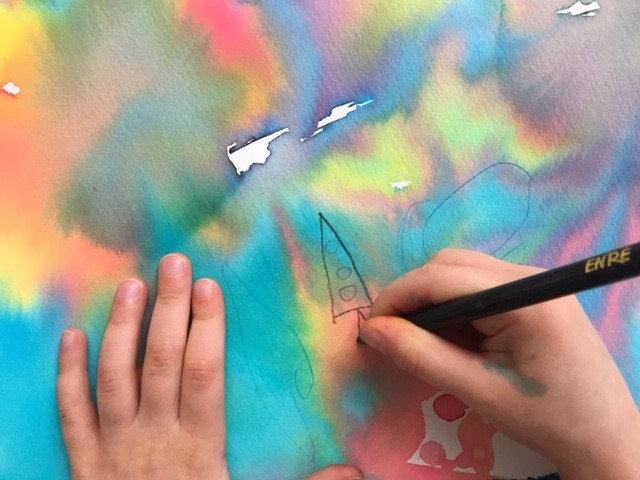
the top of a rocket

Next came a rocket!

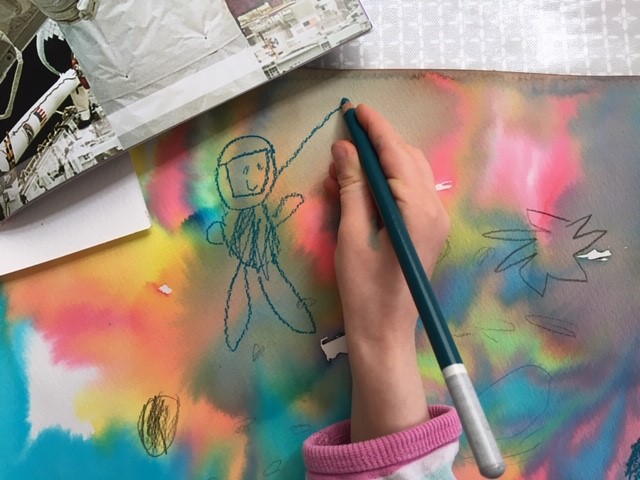
drawing an astronaut

And then the astronaut, he she decided was a girl astronaut called Sally.
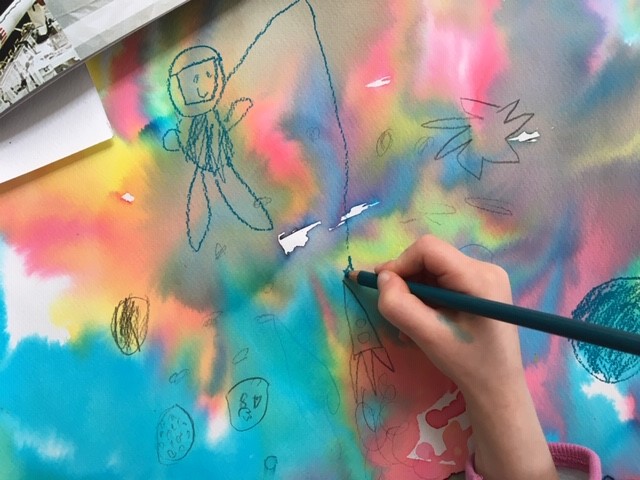
astronaut on her space walk

Depending on your child’s attention span, this could take up half an hour or so – or even more! They may leave the picture and come back to it. Above all, keep it relaxed and open ended – and have fun!
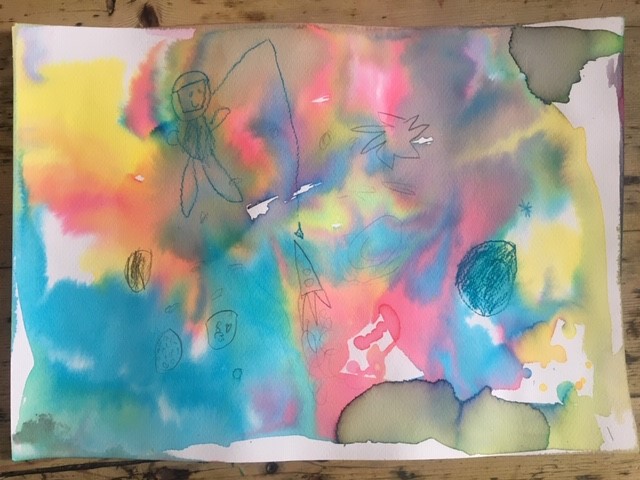
space drawings added

You can see more of Rachel’s resources here.


This is a sample of a resource created by UK Charity AccessArt. We have over 1500 resources to help develop and inspire your creative thinking, practice and teaching.

AccessArt welcomes artists, educators, teachers and parents both in the UK and overseas.

We believe everyone has the right to be creative and by working together and sharing ideas we can enable everyone to reach their creative potential.


“Missing You” – Pavement Art Response to #SchoolclosureUK


Drawing Large

See This Resource Used in Schools…

Trinity & St Michael’s CE, Croston, Year 3, teacher Mrs Tracey Drury
Year 3 of Cuddington Primary School, Northwich, Cheshire

You Might Also Like…

Pathway: Gestural Drawing with Charcoal

Covering newsprint in charcoal

Featured in the ‘Gestural Drawing with Charcoal Pathway’

Session Recording: exploring Charcoal

Compressed Charcoal Using Point By Lancelot Richardson

The ancient art of konan

A Charmed Life BBC Short https://www.bbc.co.uk/programmes/p078rmpr

Molly Hausland

Molly Haslund Circles (2013) Museum of Contemporary Art, Roskilde, Denmark Photo by Matilde Haaning


Home: The Little House on West Street LockDown Project


Inspired! Making at Linton Heights Junior School


Mono Printing Session with ‘Change, Grow, Live’

You May Also Like…

Pathway: Exploring the world though mono print

Carbon and oil pastel mono print

This is featured in the ‘Exploring The World Through Mono print’ pathway

Talking Points: Xgaoc’o Xare

Two giraffe and two birds II 50x65sm by Qhaqhoo Xgaoc'o X'are

Video enabled monoprint resources

Final Monotype by Tobi Meuwissen


Rainbows and Waves for Grey Days


Drawing Small

You May Also Like…

Pathway: Exploring the world though mono print

Carbon and oil pastel mono print

This is featured in the ‘Exploring The World Through Mono print’ pathway

Drawing Large

Arthur Beresford Jones


Printed Houses


Inspired! Re-Creating Cupid and Psyche in Mixed Media by Year Fives at Linton Heights


Inspire 2020: Introducing Colour and Egg Tempera on a Gesso Panel


A Progression Pathway in Clay Work

From Early Years

Woodland Exploration by Caroline Wendling & Deborah Wilenski

Artists Caroline Wendling and Deborah Wilenski encourage young children in a woodland exploration using art and imagination as their discovery tools. Artists Caroline Wendling and Deborah Wilenski encourage young children in a woodland exploration using art and imagination as their discovery tools.

Nest By Paula Briggs

Paula gives children the tools to both draw and make. Children worked with hard and soft pencils, graphite, wax resist, watercolour, clay and sticks. Paula gives children the tools to both draw and make. Children worked with hard and soft pencils, graphite, wax resist, watercolour, clay and sticks.
From Key Stage One

How to Clay Play

This resource, commissioned by Cambridge City Council, encourages being together through making and introduces the basics of working with Scolaquip air-hardening clay. This resource, commissioned by Cambridge City Council, encourages being together through making and introduces the basics of working with Scolaquip air-hardening clay.

Ofsted are Coming Tomorrow!

Primary school teacher, Sue Brown, shares her experience of an Ofsted Deep Dive in Art and gives advice to other teachers on how they might prepare themselves. Primary school teacher, Sue Brown, shares her experience of an Ofsted Deep Dive in Art and gives advice to other teachers on how they might prepare themselves.

Quick Clay Figurative Sketches By Paula Briggs

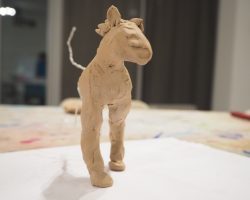
Paula provided young children with the opportunity to explore clay as a “short term” construction and modelling material. Without being fired, the dry clay has a limited lifespan, and the sculptures will crumble, but I think it’s important to remind oursleves that even without access to a kiln, clay can still be regarded as a valuable sculptural material. Paula provided young children with the opportunity to explore clay as a “short term” construction and modelling material. Without being fired, the dry clay has a limited lifespan, and the sculptures will crumble, but I think it’s important to remind oursleves that even without access to a kiln, clay can still be regarded as a valuable sculptural material.

Decorative Clay Coil Pots by Sharon Gale

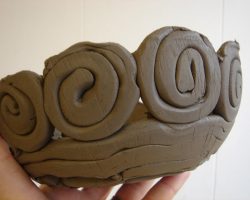
This simple clay pot making resource is not the traditional way of making coil pots but it’s lots of fun and by using different paint effects, the end results can be very interesting. We worked on this project for two, two-hour sessions. This simple clay pot making resource is not the traditional way of making coil pots but it’s lots of fun and by using different paint effects, the end results can be very interesting. We worked on this project for two, two-hour sessions.

Making Plaster Reliefs By Paula Briggs

This resource describes how to create plaster reliefs using clay and foamboard moulds. It is based upon a session which took place at Bourn Primary Academy with a group of Year 5 children. This resource describes how to create plaster reliefs using clay and foamboard moulds. It is based upon a session which took place at Bourn Primary Academy with a group of Year 5 children.

Clay Art Medals by Sharon Gale

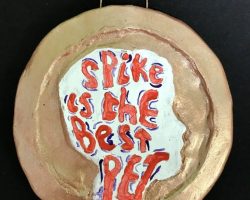
In this three stage resource, students make a circular medal from clay depicting their own profile, look at examples of fun lettering and devise a short, fun or meaningful phrase to paint inside their portrait profile. Clay art medals are a fun way to link class topics with an art activity. In this three stage resource, students make a circular medal from clay depicting their own profile, look at examples of fun lettering and devise a short, fun or meaningful phrase to paint inside their portrait profile. Clay art medals are a fun way to link class topics with an art activity.

Japan: Making Sushi – Recycled Style! By Jan Miller

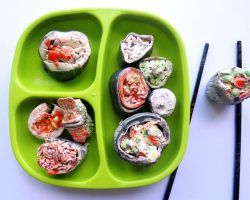
Inspired by research into Japanese culture, children explored the potential and limitations of paper and recycled materials, learning through play and experimentation to make 3D forms. The outcomes of this process were used to inform work created in a second medium of clay, using kitchen equipment to shape the clay and add textures. Inspired by research into Japanese culture, children explored the potential and limitations of paper and recycled materials, learning through play and experimentation to make 3D forms. The outcomes of this process were used to inform work created in a second medium of clay, using kitchen equipment to shape the clay and add textures.

From Key Stage Two

Japan – Ceramics Inspire Painting and Painting Inspires Ceramics By Jan Miller

Jan shares a Year Three class project that uses the work of a contemporary Japanese ceramicist to inspire vibrant paintings in a variety of materials. The children then used their own art to design ceramic vessels. Jan shares a Year Three class project that uses the work of a contemporary Japanese ceramicist to inspire vibrant paintings in a variety of materials. The children then used their own art to design ceramic vessels.

Clay ‘Portrait’ Miniatures by Sharon Gale

Portrait miniatures are small painted images, usually of monarchs and very wealthy, important people. Dating back to the 1520s, these tiny portraiture paintings are like medals, but with realistic colour. This two stage clay and painting resource is very versatile because essentially the miniatures are blank canvasses. Portrait miniatures are small painted images, usually of monarchs and very wealthy, important people. Dating back to the 1520s, these tiny portraiture paintings are like medals, but with realistic colour. This two stage clay and painting resource is very versatile because essentially the miniatures are blank canvasses.

Clay Slab Work by Andy Cairns

This resource explores how to make an armature and use clay slab to build a form. Based upon the legend of “Black Shuck”, a ghostly dog that roams the coast searching for its drowned masters, this project engaged the children and resulted in charismatic sculptures, but you could equally transfer the activity to other themes. This resource explores how to make an armature and use clay slab to build a form. Based upon the legend of “Black Shuck”, a ghostly dog that roams the coast searching for its drowned masters, this project engaged the children and resulted in charismatic sculptures, but you could equally transfer the activity to other themes.

Fruit-Inspired Clay Tiles By Rachel Dormor

Ceramicist Rachel Dormor shares a workshop idea suitable for primary or secondary aged children. Working in clay, pupils take their inspiration from drawings of fruit to make decorative clay tiles. Ceramicist Rachel Dormor shares a workshop idea suitable for primary or secondary aged children. Working in clay, pupils take their inspiration from drawings of fruit to make decorative clay tiles.

Fruit Pinch Pot Project By Rachel Dormor

Ceramicist Rachel Dormor shares a workshop idea suitable for primary or secondary aged children. Working in clay, pupils take their inspiration from drawings of fruit to make simple pinch pot mugs. Ceramicist Rachel Dormor shares a workshop idea suitable for primary or secondary aged children. Working in clay, pupils take their inspiration from drawings of fruit to make simple pinch pot mugs.

From Key Stage Three and Beyond

Chimera Drawings into Beautiful Terracotta Tiles By Eleanor Somerset

Sgraffito, or ‘scratching’ is a technique which is an excellent way to reinforce mark making with all age groups.
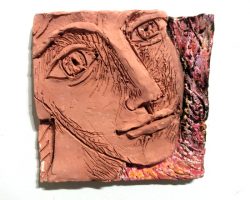
Drawing into leather hard red clay tiles to create designs using mark-making can be even more effective when done through a white earthernware slip to reveal the red clay beneath. Sgraffito, or ‘scratching’ is a technique which is an excellent way to reinforce mark making with all age groups.
Drawing into leather hard red clay tiles to create designs using mark-making can be even more effective when done through a white earthernware slip to reveal the red clay beneath.

Exploring Materials: Clay and Water by Sheila Ceccarelli

Sheila asked teenagers at AccessArt’s Experimental Drawing Class when the last time was that they had played with clay? Sheila asked teenagers at AccessArt’s Experimental Drawing Class when the last time was that they had played with clay?

Arts and Minds: Manipulating Clay with Water by Sheila Ceccarelli

This post shows how to facilitate a sensory session exploring water and clay - by Sheila Ceccarelli (artist) and Yael Pilowsky Bankirer (Psychotherapist) for Arts and Minds. This post shows how to facilitate a sensory session exploring water and clay – by Sheila Ceccarelli (artist) and Yael Pilowsky Bankirer (Psychotherapist) for Arts and Minds.

Painted Clay by Melissa Pierce Murray

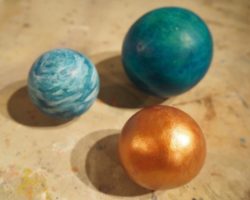
This post was inspired by the Japanese art of dorondongo, where mud and dirt are shaped and buffed into highly polished spheres. We made clay spheres and other simple forms in clay, and once dry, painted them with ink and acrylic. This post was inspired by the Japanese art of dorondongo, where mud and dirt are shaped and buffed into highly polished spheres. We made clay spheres and other simple forms in clay, and once dry, painted them with ink and acrylic.

Exploring Portraits with Eleanor Somerset

In this resource artist, Eleanor Somerset shows how she led students in The Little Art Studio, Sheffield, to explore and discover portraiture through various media. In this resource artist, Eleanor Somerset shows how she led students in The Little Art Studio, Sheffield, to explore and discover portraiture through various media.

Introducing Sgraffito using a Coloured Clay Slip on a Terracotta Tile By Eleanor Somerset

Further explore how to make beautiful sgraffito, or ‘scratched drawings’ with artist Eleanor Somerset. Further explore how to make beautiful sgraffito, or ‘scratched drawings’ with artist Eleanor Somerset.

From Bones and Body to Structure and Form By Melissa Pierce Murray

Artist Melissa Pierce Murray worked with teenagers from AccessArt’s Experimental Drawing Class on a series of workshops which physically explored drawing and sculptural responses to form, forces and anatomy. Artist Melissa Pierce Murray worked with teenagers from AccessArt’s Experimental Drawing Class on a series of workshops which physically explored drawing and sculptural responses to form, forces and anatomy.

Simple Clay Moulds by Melissa Pierce Murray

In this post, artist Melissa Pierce Murray, shows, step-by-step, how young teenagers explored plaster casting by making simple clay ‘waste moulds’ and then moved on to making simple ‘two piece moulds’. In this post, artist Melissa Pierce Murray, shows, step-by-step, how young teenagers explored plaster casting by making simple clay ‘waste moulds’ and then moved on to making simple ‘two piece moulds’.

Casting a Negative Space in Plaster with Sculptor Rachel Wooller

Resident artist at ArtWorks Studios, Cambridge, Rachel Wooller, introduces teenagers at AccessArt’s Experimental Drawing Class to the process of casting and creating negative shapes in plaster from clay positives. Resident artist at ArtWorks Studios, Cambridge, Rachel Wooller, introduces teenagers at AccessArt’s Experimental Drawing Class to the process of casting and creating negative shapes in plaster from clay positives.

Rowan: Clay Coiling Techniques to Make Penguins, Tweety Pie and a Dalek too! by Abi Moore and Sarah Nibbs

Abi, Sarah and students at Rowan Humberstone, show how they made clay birds using clay coiling techniques and with a plaster mould for the birds’ bases. Abi, Sarah and students at Rowan Humberstone, show how they made clay birds using clay coiling techniques and with a plaster mould for the birds’ bases.

Rowan: Making a Clay Bird from a Mould by Abi Moore and Sarah Nibbs

Abi and students from Rowan Humberstone, describe how they made clay birds from a plaster mould. Abi and students from Rowan Humberstone, describe how they made clay birds from a plaster mould.

Modelling The Head in Clay by Melissa Pierce Murray

Artist Melissa Pierce Murray led a series of workshops for AccessArt’s Experimental Drawing Class in which the teenagers modelled a head in clay. There are five resources in this series, beginning with constructing an armature and making preparatory drawings, then studying the bone structure of the skull before moving on to features. The final post in this series looks at ways to increase the techniques and approaches used in drawing. Artist Melissa Pierce Murray led a series of workshops for AccessArt’s Experimental Drawing Class in which the teenagers modelled a head in clay. There are five resources in this series, beginning with constructing an armature and making preparatory drawings, then studying the bone structure of the skull before moving on to features. The final post in this series looks at ways to increase the techniques and approaches used in drawing.

Design Lab: Phoebe Cummings at the V&A

Students, from the DesignLab at the V&A, London, worked with artist Phoebe Cummings over a three month period to create a site-specific, group piece, from unfired clay which was inspired by the historical 2D designs found on 19th century British tableware in the collection. Students, from the DesignLab at the V&A, London, worked with artist Phoebe Cummings over a three month period to create a site-specific, group piece, from unfired clay which was inspired by the historical 2D designs found on 19th century British tableware in the collection.


Inspired! Psyche’s Resilience by The Fitzy Peters


Life Drawing Class: Visual Impressions


Inspired! ‘The Tree’ by Year One and Two at Hauxton Primary School


Ofsted are Coming Tomorrow!


Walking and Drawing


Unesco: Celebrating the Power of Making!


Children’s Community Project


Foreshortened Sketches