Making Time for Sketchbooks in Schools

How can we embed the use of sketchbooks in our school day and help learners get into the sketchbook habit?

Use of Sketchbooks in Primary School

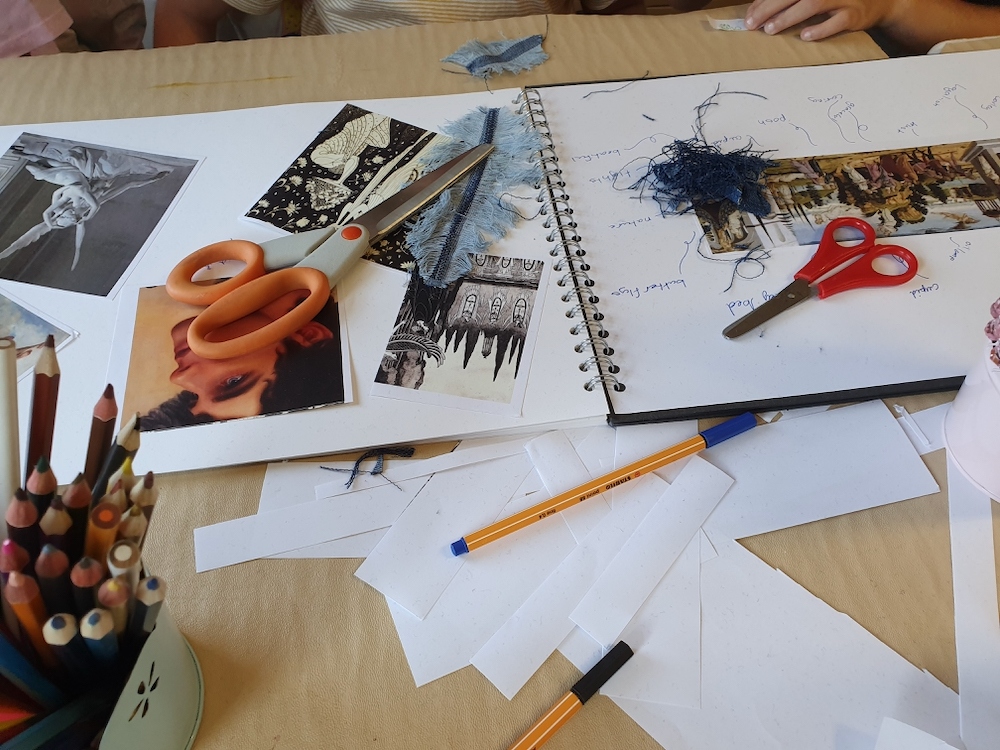
When thinking about how to slot sketchbook use into the school day, especially in primary schools, the key is to think little and often. Regular opportunities for practice, combined with open access to sketchbooks will help create momentum and energy, which in turn will help creativity flourish in all areas (beyond the sketchbook too). The opposite scenario to this is one where the sketchbooks are kept in a box, pulled out once every couple of weeks, and the same sketchbook is used for many terms (which we want to avoid).

“I think getting into the “habit” is really important (for children and adults). regular use is key, even if it is just five/ten minutes, but if it is five ten minutes every morning, then switching into sketchbook mode gets easier and easier. We provide children with short quick activities to get them to tune in.” Clare

Whilst sketchbooks can of course be used in art lessons to help facilitate a creative learning journey, there is also a value in being open, and embedding sketchbooks throughout the school day, so that their benefits can ripple out into other subject areas. Creativity is a skill which underpins (or at least should underpin) all learning.

If you are uncertain as to whether there is an opportunity to use sketchbooks within certain lessons, ask these questions:

Would the pupils benefit from thinking around the subject area? Would their learning be deeper, more active, and more relevant if they were given space to experience the subject area from a number of perspectives?

If the answer is yes, then sketchbooks can help.

Lots of different activities take place in sketchbooks, and each type of activity can help develop a different behaviour.  In the same way, sketchbooks can be used at many different points of the day, and each time of the day offers an opportunity to develop different skills:

Using sketchbooks at the start of the day can help children transition, and provide an opportunity to focus and open their mind to think creatively.

Using sketchbooks at the end of the day can help provide an opportunity for reflection and absorption of ideas.

Giving learners access to sketchbooks in their free time (lunchtime, at home) can help build a sense of ownership of their own learning.

Simple ways to help embed sketchbook use in the school day

1) Encourage regular practice. Use sketchbooks for a regular 5-10 minute exercise. Commit to fill x pages a week to start to understand how momentum is built. Intersperse a given exercise, for example a continuous line drawing, with activities which enable the individual learner to take the sketchbook work in their own direction, for example by answering an open-ended question such as “how many worms are there in the world.”

2) Identify moments of time which can be filled. Find a slot in your day that is otherwise occupied. Carry the sketchbook at those times, and begin to create a connection between that time and your sketchbook.

3) Impose variety. Challenge learners to fill pages in different ways. Let one action lead to another. For example, if you normally start by making a drawing, consciously start to include words on that or the next page. Purposefully use colour and different media. Even if it feels forced in the first instance, expanding the kinds of marks, notes or actions you make WILL help expand your thoughts and get you into the habit of sketchbook-like thinking.

“At our school the children start each day by working for 10 mins in their ‘thinking books’. Staff pose a question via the whiteboard to encourage thinking skills and children respond via drawing. We plan to develop this into richer sketchbook use over the next term.”


This is a sample of a resource created by UK Charity AccessArt. We have over 1500 resources to help develop and inspire your creative thinking, practice and teaching.

AccessArt welcomes artists, educators, teachers and parents both in the UK and overseas.

We believe everyone has the right to be creative and by working together and sharing ideas we can enable everyone to reach their creative potential.
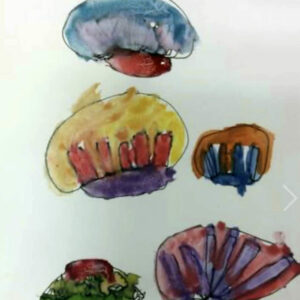
Water Soluble Felt-Tips With Complementary Colours

See How This Resource Is Used in Schools…

DSCN4456
Year 1/2, Ruardean C of E Primary School

You May Also Like…

Pathway: Spirals

This resource is in the 'Spirals' pathway.

This resource is in the ‘Spirals’ pathway.

the drawing journey

Drawing Architecture by Phil Dean

Layered Colour Gestural Drawing

orangeyellow


Animal Habitats: An Ecological Mural of Planet Earth


Raising Aspirations

You May Also Like…

Assessment & Progression

Pocket Gallery


How I use my Sketchbook as a Painter and Maker, by Rowan Briggs Smith: Anatomy Sketchbooks


Art Club Cafe


Shadow Puppet Making and Performance


Back – Painted Portraits


Mark Making & Sound: Part Three

You May Also Like…

Pathway: Music and art

This is featured in the 'Music and Art' pathway

This is featured in the ‘Music and Art’ pathway

Mark Making & Sound: Part One

Mark Making and Sound

Mark Making & Sound: Part Two

Mark Making and Sound


Mark Making & Sound: Part Two

You May Also Like…

Pathway: Music and art

This is featured in the 'Music and Art' pathway

This is featured in the ‘Music and Art’ pathway

Mark Making & Sound: Part One

Mark Making and Sound

Mark Making & Sound: Part Three

WhatsApp Image 2020-10-06 at 10.45.45 (4)


Mark-Making & Sound: Part One

You May Also Like…

Pathway: Music and art

This is featured in the 'Music and Art' pathway

This is featured in the ‘Music and Art’ pathway

Mark Making & Sound: Part Two

Mark Making & Sound

Mark Making & Sound: Part Three

WhatsApp Image 2020-10-06 at 10.45.45 (4)

Drawing to a Slow Rhythm

Drawing to a Slow Rhythm

Inspired by Miro

Screenshot 2020-10-10 at 09.37.17

Drawing to Music

Screenshot 2020-10-10 at 09.39.25


Ink Collage Inspired by The Wolf Wilder


AccessArt Drawing Prompt Cards


Introduction To Forest Of Imagination


You And Me Make Tree


Raising the Profile of the Art Department


Being an Artist Teacher


Patterns with Nature

You May Also Like…

Pathway: Explore and Draw

Featured in the 'Explore and Draw' Pathway

Featured in the ‘Explore and Draw’ Pathway

Talking Points: Artists as Collectors and explorers

artists as collectors

AccessArt Digital Resources

Painting patterns using Draw and Tell digital painting tool.


Making a Scroll Drawing


Shells: Observational and Imaginative Drawing

You May Also Like…

Still Life Compositions

Freyas Painting By Joanne Andrews

Drawing Spiral Snails

Drawing a spiral with chalks

Drawing Spirals

Careful control of spiral